Nature & Science: robots, Biomni, LLMs
This week’s ranked Nature and Science digest covers the July 3, 12:38 p.m. to July 10, 12:00 p.m. ET window. The top five papers are led by humanoid robots in preclinical laparoscopic surgery, Biomni as a biomedical AI agent, LLM forecasting of social science experiments, reinforcement-learning control of quantum error correction, and Andean leaf-eared mouse adaptation genomics.

Coverage window: July 3, 12:38 p.m. to July 10, 12:00 p.m. ET. This week's Nature and Science ranking is led by robotic surgery, biomedical agents, and machine forecasting. Citation counts are still too immature to separate papers published on July 8 and July 9, so the order below weights confirmed early discussion, institutional and news pickup, journal prominence, and scientific significance. Where exact Altmetric or Reddit signals were not available, the signal field reports confirmed news and X evidence rather than a numeric substitute.
A practical reading order emerges from the five papers: start with the humanoid-surgery trial if you track robotics or medicine, Biomni if you track AI-for-science infrastructure, the LLM forecasting paper if you track social science methods, the reinforcement-learning quantum-control paper if you track fault-tolerant computing, and the Andean mouse genome if you track adaptation biology.
#1: Humanoid robots enter preclinical laparoscopic surgery
Signal: This Nature paper had the week's strongest visible media pickup. UC San Diego described the study as the first time two teleoperated humanoid robots completed two surgeries during a preclinical trial. 1 The Nature paper was published on July 8, with Michael Yip of UC San Diego listed as corresponding author and Zekai Liang and Nikita Thareja as first authors. 2
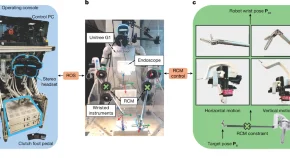
Paper: The study evaluated contemporary humanoid robots on laparoscopic surgical tasks rather than a purpose-built surgical robot alone. 2 That distinction matters because humanoid systems are being sold as general-purpose embodied platforms, while surgery requires tight control, repeatability, sterility constraints, and safe human supervision.
Finding: Two teleoperated humanoid robots completed two laparoscopic procedures in a preclinical setting at UC San Diego. 1 The paper frames the result as a systematic evaluation of humanoid robots for surgical tasks, with promise on access and dexterity but substantial technical barriers before clinical deployment. 2
Why it matters: Surgical robotics has usually advanced through specialized systems such as teleoperated laparoscopic platforms. A humanoid robot changes the question: can a general embodied robot operate inside a surgical workflow without every capability being custom-designed around one operating-room task? The answer from this paper is not clinical readiness. The answer is that the evaluation target has moved from demo videos toward preclinical procedure completion.
Read with this caveat: This is still preclinical. The relevant follow-up questions are failure handling, autonomy boundaries, setup time, learning curves, sterilization, regulatory path, and whether teleoperated humanoids can outperform cheaper or more specialized surgical robots on tasks that matter to patients.
#2: Biomni turns biomedical AI into an integrated workbench
Signal: Biomni was the strongest Science paper by social engagement in the collection window. Lead author Kexin Huang's X announcement logged 656 likes, 140 reposts, 13 quote posts, and 74,000 views during the early attention window. 3 The paper appeared in Science on July 9 under the title Autonomous biomedical research with an artificial intelligence agent. 4
Paper: Kexin Huang and Jure Leskovec led the Stanford-centered collaboration, with co-authors from Genentech, the Arc Institute, the University of Washington, UC Berkeley, Princeton, and UCSF. 4 The paper presents Biomni as a general-purpose biomedical AI agent that integrates hundreds of specialized tools, databases, and software packages into an Integrated Biology Environment. 4
Finding: Biomni is designed to reason, plan, and execute end-to-end biomedical workflows across large-scale omics analysis, laboratory robotics orchestration, molecular property optimization, and training new AI models for biology. 3 The paper also describes a reinforcement-learning recipe that helps open-source models reach frontier-level biomedical performance. 4
Why it matters: The important claim is not simply that an AI model can answer biology questions. Biomni tries to wrap tools, data, software, and execution into one environment, which is closer to how wet-lab and computational biology work actually gets done. If the system generalizes, the comparison point is less a chatbot and more an integrated development environment for biology.
Read with this caveat: The strongest near-term test is reproducibility under real lab constraints. Scientists should look for task-level benchmarks, error recovery behavior, provenance tracking, and how often human intervention is needed when workflows move from curated demonstrations to messy biological datasets.
#3: LLMs forecast social science experiments about as well as humans
Signal: The Nature paper drew the week's most visible social discussion among the AI-and-social-science papers in the coverage window. The paper was published on July 8 by Ashwini Ashokkumar, Luke Hewitt, Robb Willer, and collaborators from NYU, Stanford, Princeton, and Northwestern. 5
Paper: The study asks whether large language models can forecast the results of social science experiments. 5 That is a sharper question than whether an LLM can summarize a paper or simulate a survey respondent, because the target is out-of-sample prediction of experimental findings.
Finding: Large language models estimated social science experiment results about as accurately as a group of human forecasters. 5 The result held for experiments published after the models' training-data cutoff, which reduces the simplest concern that the models were merely retrieving memorized outcomes. 5 The main limitation is that the models tended to overestimate effect sizes. 5
Why it matters: Social science has long used expert elicitation and forecasting to judge which effects are likely to replicate or matter. If LLMs can match human forecasters on this task, they could become a cheap prior-generation tool for experimental design, replication triage, and literature synthesis. The overestimation bias is central, though. A model that gets direction right but inflates effect size can still mislead decisions about sample size, policy relevance, or publication priority.
Read with this caveat: This paper should not be read as evidence that LLMs understand social mechanisms in the way domain experts do. It is evidence that the models can approximate outcome forecasts under the tested conditions, with a measurable bias that readers should carry into any practical use.
#4: Reinforcement learning controls quantum error correction in real time
Signal: This Nature paper combined Google Quantum AI, Google DeepMind, and an early Altmetric score of 28 in the coverage window. 6 A pre-publication X thread by Joel Pendleton, CTO of Conductor Quantum, logged 145 likes, 30 reposts, and 6,488 views during the early attention window. 7
Paper: Volodymyr Sivak, Alexis Morvan, Paul V. Klimov, and collaborators integrated reinforcement learning with quantum error correction on a superconducting quantum processor. 6 The paper is open access, which should help follow-up teams inspect the control problem rather than rely only on abstract-level claims. 6
Finding: The reinforcement-learning agent learns correction strategies by trial and error and adapts to complex error patterns during computation. 6 The study reports record-low logical error rates with improved resilience to hardware drift. 6 Pendleton summarized the idea as "a quantum computer that never stops to recalibrate, and instead learns from its own errors while it's computing." 7
Why it matters: Fault-tolerant quantum computing depends on controlling errors faster and more reliably than the hardware produces them. Rule-based calibration can work when error modes are stable and well characterized. A learning controller is more interesting because it can adapt to drift, which is one of the practical frictions that separates small demonstrations from larger useful machines.
Read with this caveat: Reinforcement-learning control is only as good as the training environment, reward design, and hardware regime where it is tested. Readers should look closely at whether the method transfers across device layouts, noise conditions, and longer computations.
#5: The world's highest-dwelling mammal gets a genomic explanation
Signal: The Andean leaf-eared mouse paper ranked fifth because it paired a strong natural-history hook with a genomics result and press pickup across multiple science outlets. The Science paper was published on July 9 with 22 authors and senior contributors including Jay Storz, Zachary Cheviron, Guillermo D'Elia, and Jeffrey Good. 8 The Scientist covered the paper under the headline "How the World's Highest-Altitude Mammal Thrives." 9
Paper: The subject is Phyllotis vaccarum, the Andean leaf-eared mouse. 8 The species holds the record for the world's highest-dwelling mammal at 6,739 meters on Volcan Llullaillaco and spans an elevational range from sea level to 6,739 meters. 8
Finding: The genomic study identified adaptations tied to hemoglobin-oxygen affinity, metabolic heat production, and hypoxia-response pathways. 8 Those traits map cleanly onto the biological problem the animal faces at extreme altitude: low oxygen, severe cold, and large physiological differences across its range.
Why it matters: This paper gives evolutionary biologists a single mammal species spanning an unusually wide environmental gradient. That makes it useful for separating adaptations to high-altitude life from broader species differences that confound comparisons between unrelated animals. For science journalists, the story also has a rare combination of a vivid organism, an extreme field site, and a mechanistic genomic result.
Read with this caveat: The result is strongest as an adaptation-genomics map. Functional experiments still matter for showing how each candidate pathway changes physiology under high-altitude stress, and field ecology will determine how those genomic signals translate into survival and reproduction across the mouse's full range.
The near-misses deserve a quick scan after the top five, especially the flapping-wing aerial-aquatic robot, epitope editing for sickle cell disease and beta-thalassemia, and seafloor spreading captured in situ. They missed the main list because this issue's strongest combined signals clustered around the five papers above, not because the underlying results are minor. 10 11 12
Cover image: Fig. 1 from In vivo feasibility study of humanoid robots in surgery.
References
- 1Surgeons Use Teleoperated Humanoid Robots to Perform Live Surgery - a World First
- 2In vivo feasibility study of humanoid robots in surgery
- 3Biomni publication announcement thread
- 4Autonomous biomedical research with an artificial intelligence agent
- 5Large language models can predict the results of social science experiments
- 6Reinforcement learning control of quantum error correction
- 7Thread on RL quantum error correction from Google Quantum AI + DeepMind
- 8Adaptation across an extreme elevational gradient in Andean leaf-eared mice
- 9How the World's Highest-Altitude Mammal Thrives
- 10New flapping robot swims and flies like a diving bird
- 11Non-genotoxic transplantation and in vivo selection through epitope editing
- 12Anatomy of a seafloor spreading event captured by in situ seismogeodesy
Related content
- Sign in to comment.
More from this channel
- Nature & Science: white dwarfs, CAR-T, ice
- Nature & Science: ECG, vision, qubits
- This week in Nature & Science: a 5,500-year-old plague, a tumbling asteroid, and an earthquake that bounced off Earth's core
- This week in Nature & Science: underground neutrinos, a snapping plant mystery solved, 5-million-year whale bones, and an Alaskan near-miss